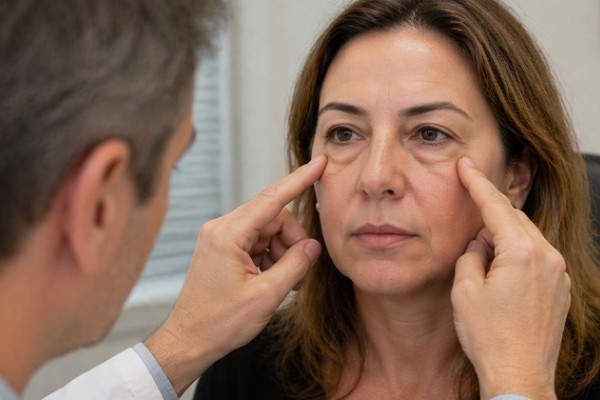

What is SMAS Facelift and Why is it So Important?
SMAS facelift is a modern facelift technique that provides a more natural and long-lasting rejuvenation by lifting not only the skin of the face but also the sagging support tissues.
Facelift surgeries have undergone a significant transformation from the past to the present. While methods that only tightened the skin were applied in the past, the goal today is not simply to make the face look tight; it is to more accurately return the anatomical structure of the face to its position during youth. For this reason, the SMAS technique forms the basis of the modern approach within smas facelift surgeries.
SMAS (Superficial Musculoaponeurotic System) is the layer of connective tissue that carries the mimic muscles and soft tissues of the face, acting as a bridge between the skin and the muscles. This structure is the main support system of the face and shifts downward with aging.
How Does SMAS Facelift Work?
During the aging process, it is not only the skin that loosens; the deep tissues of the face also shift downward. The cheeks drop, the jawline loses its definition, and the facial contour is disrupted. In SMAS facelift surgery, not only the skin is tightened; this support system is also reshaped and repositioned. Thus, the result is not only tight but also balanced, natural, and longer-lasting.
The SMAS Technique According to Op. Dr. Oğuzhan Aydoğdu
Facelift surgeries have been performed using many different techniques throughout the history of plastic surgery. Based on my own clinical experience, I can clearly say: surgeries where only the skin is tightened often do not provide sufficiently natural and permanent results. This is because facial aging is not just about the skin, but about the displacement of deep tissues.
In the surgeries I perform, I actively use the SMAS structure; in procedures performed without including the SMAS, an excessive load is placed on the skin, and re-sagging becomes inevitable over time. In my own practice, I prefer the deep plane facelift approach, which gives the strongest result, especially in advanced cases.
How is SMAS Facelift Performed?
SMAS facelift surgery can be performed with different techniques, but the fundamental goal is the same: to provide a more natural and balanced rejuvenation by supporting the support system of the face.
- SMAS plication: The SMAS tissue is tightened by folding.
- SMASectomy: Excess SMAS tissue is removed.
- SMAS flap: The SMAS is lifted and repositioned; it provides the strongest lifting effect.
What is the Difference Between Classic Facelift and SMAS?
In classic facelift surgeries, only the skin is tightened. This often creates a feeling of artificial tension. In the SMAS technique, it is not the surface but the support system that is supported. In this way, both a more natural appearance is achieved and the results are preserved for a much longer time.
| Feature | Classic (Skin Lift) | SMAS Facelift |
|---|---|---|
| Target Area | Skin only | Skin + SMAS |
| Naturalness | Low | More natural |
| Longevity | 2-4 years | 5-10 years |
| Feeling of Tightness | High | Less |
| Depth of Effect | Superficial | Deeper |
Who is a Suitable Candidate for SMAS Facelift?
- Those with significant sagging in the face
- Those who have lost their jawline and cheek contour
- Patients who want a more natural and long-lasting result
- Patients who would not get sufficient results with skin tightening alone
How Long Does a SMAS Facelift Last?
SMAS facelift surgery generally provides longevity between 5 and 10 years. This is because not only the skin but also the support system of the face is restructured. Although the aging process continues, the face continues to age from a younger point.
Is SMAS or Deep Plane More Effective?
SMAS techniques tighten and support the face; however, this may not be sufficient for some patients. In more advanced cases, the tissues need to be completely repositioned, and at this point, the deep plane approach provides stronger and more natural results.
Conclusion: Facelift is No Longer Just Tightening
Facelift surgery is no longer just about tightening the skin. The goal is not to make the face look tighter, but to achieve a younger, more rested, and more natural appearance. The correct choice of technique and the surgeon's experience are the most decisive factors in this process.
Frequently Asked Questions
Is SMAS facelift a painful surgery?
There may be mild pain and tension after the surgery, but most patients go through the process much more comfortably than they expected.
Will there be scars after a SMAS facelift?
Incisions are hidden in natural areas such as around the ears and the scalp. Scars lose their prominence over time and are not noticeable from the outside.
When can I return to social life?
Returning is usually possible within 2–3 weeks.
Is SMAS or deep plane better?
This is determined entirely according to the patient's needs.