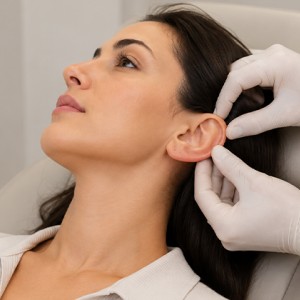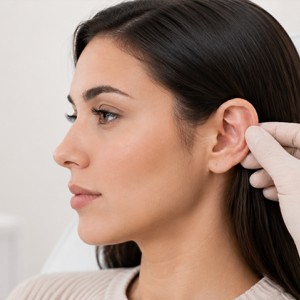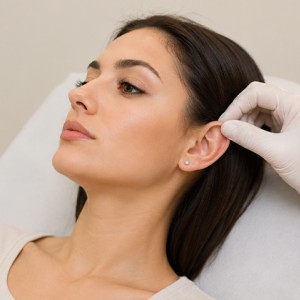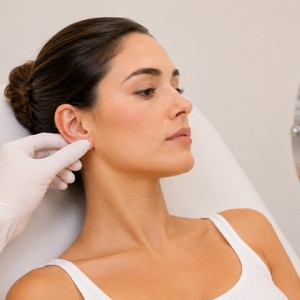
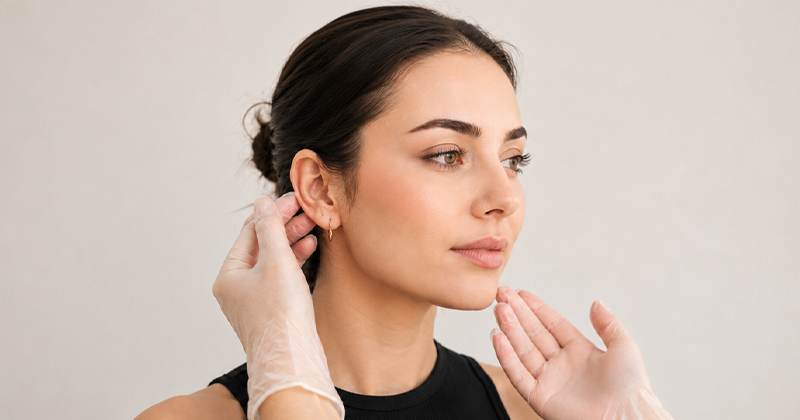
What is Ear Aesthetics (Otoplasty)?
Ear aesthetics (otoplasty) includes aesthetic surgery procedures aimed at improving the angle, size, shape, and symmetry of the ears with the head. When planning ear aesthetics in Samsun, the goal is not to hide the ears, but to obtain a more balanced and natural ear appearance compatible with the face.
Ears are important structures that complete the facial expression, especially when viewed from the front and profile. The appearance of prominent ears, ears being larger than normal, or a significant asymmetry between the two ears can be factors that affect self-confidence, especially during childhood and adolescence. Ear aesthetics aims to correct these situations in accordance with facial proportions.
In Which Complaints is Ear Aesthetics Considered?
The most frequently mentioned complaints in Samsun ear aesthetics applications are as follows:
- Ears appearing very separated from the head when viewed from the front (prominent ear appearance)
- Ears being disproportionately large with the face
- Significant size or shape difference between the two ears (asymmetric ear)
- Deterioration in the shape of the ear after a previous operation or trauma
While prominent ear aesthetics is sufficient for some patients, more specific procedures such as ear reduction or earlobe aesthetics may come to the agenda for others.
Psychological Impact of Aesthetic Appearance
The shape and angle of the ear can cause behaviors such as being teased, hiding the ear with hair, and avoiding taking photographs, especially during childhood and adolescence. Ear aesthetics is an intervention that can positively affect not only the physical appearance but also self-confidence and social comfort.
What Procedures Does Ear Aesthetics Cover?
Ear aesthetics does not consist of a single surgery; it may include different procedures according to the ear structure:
- Prominent ear aesthetics (correction of the ear-head angle)
- Ear reduction aesthetics (reduction of ear size)
- Elf ear aesthetics (special ear form requests)
- Earlobe aesthetics (correction of deformities in ear folds)
Which procedure or combination will be appropriate is determined by evaluating the ear cartilage structure, the amount of skin, and the proportions with the face during the examination.
Prominent Ear Appearance and Otoplasty
Prominent ear is an appearance that occurs as a result of the auricle making a wider angle than normal relative to the head or the folds inside the ear not being prominent enough. In this case, with prominent ear aesthetics:
- The ear-head angle can be reduced,
- In-ear folds can be made more prominent,
- Ears can be moved to a position more compatible with the face.
This procedure can generally be applied to different age groups from childhood to adult age and is often the most frequently preferred sub-heading of ear aesthetics.
Ear Size and Shape Deformities
In some patients, the problem may not be the angle of the ears with the head, but that the ears appear very large, very long, or not proportional. In this case, with ear reduction aesthetics, the parts that appear excess can be reshaped.
In addition, some shape differences that occur congenitally or later can be addressed with special design requests such as elf ear aesthetics or corrective procedures with earlobe aesthetics.
How is Ear Aesthetics Surgery Performed in Samsun?
The technique to be applied in ear aesthetics surgeries varies according to the problem in the ear, age, and the structure of the tissue. In general, otoplasty can be performed with local anesthesia + sedation most of the time, and under general anesthesia in pediatric patients.
Basic Stages of Ear Aesthetics Surgery
Although it varies according to the technique applied, the ear aesthetics process generally proceeds with these steps:
- The front and back surfaces of the ear are examined in detail, and measurements are made.
- According to the planned correction, incisions are made in the back of the ear or in the appropriate region.
- Cartilage tissue is reshaped, and thinning or strengthening maneuvers are applied if necessary.
- The ear is fixed with sutures by bringing it to an angle more compatible with the head.
Since the incisions are usually located behind the ear, the scars remain in regions that stay in the shadow and do not attract attention in daily life.
Ear Aesthetics in Children and Adults
Prominent ear and significant ear deformities are mostly noticed during childhood. Since the influence of the peer environment comes into play with the school period, ear aesthetics can be psychologically supportive in some children.
Age and Timing in Pediatric Patients
Since ear development is largely completed at early ages, the primary school period is accepted as the evaluation time for ear aesthetics in most children. Timing is guided by ear development, the psychological state of the child, and the decision made together with the family.
Recovery Process After Ear Aesthetics
Although the recovery process varies according to the scope of the procedure performed and the tissue structure, the general framework is as follows:
- Swelling, sensitivity, and slight bruising may be seen around the ear in the first days.
- Special bandages or protective supportive headbands for the ears can be used for a short period.
- It is important to avoid the side-lying position and the risk of impact to the ear for a while.
- Returning to daily light activities is usually possible in a short time.
It may take a few weeks for the new form of the ears to fully settle and for the swelling to completely recede. During this process, check-ups are important for monitoring the ear shape and the suture line.
Is There a Scar Left in Ear Aesthetics?
In ear aesthetics surgeries, incisions are mostly planned behind the ear or within natural folds. In this way, the scars remain in areas that do not enter the angle of view much in daily life.
The long-term appearance of scars is related to skin structure, wound healing characteristics, smoking, and compliance with postoperative care recommendations. Protection from the sun and the use of appropriate cream/tape can positively affect the scar quality.
Who is a Suitable Candidate for Ear Aesthetics?
Common situations in the Samsun ear aesthetics evaluation are:
- Ears appearing significantly separated from the head (prominent ear)
- Ear size being disproportionately large or long with the face
- Significant shape and angle difference between the two ears
- The desire to constantly hide the ears with hair due to the ear appearance
During the examination, ear cartilage structure, skin thickness, ear-head angle, and general proportion with the face are evaluated in detail. Afterwards, it is clarified whether only prominent ear aesthetics or additional procedures such as ear reduction or earlobe aesthetics will be more meaningful.