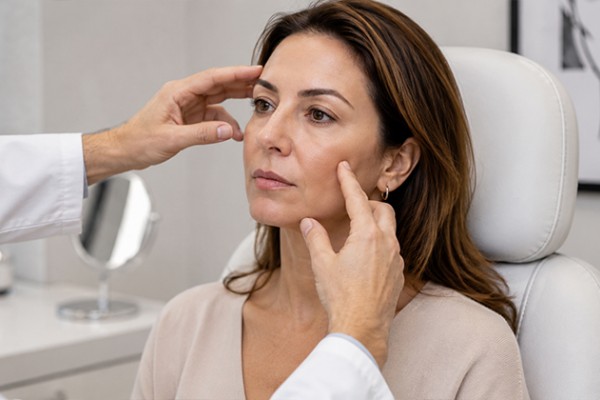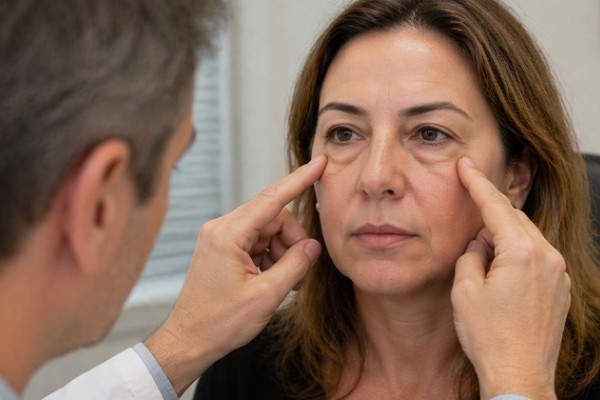

What is the Average Age for Facelift Surgery?
In my clinical practice, the vast majority of my patients applying for facelift surgery are generally 50 years of age and older. However, there is no strict age limit for this surgery. To date, the youngest patient I have operated on was 35 years old, and the oldest was 74 years old.
This wide age range clearly demonstrates that facelift surgery is planned not just based on age, but entirely according to individual anatomical and structural factors.
Is Age or Tissue More Important in Facelift Surgery?
Age is not the determining factor in facelift surgery. What is truly important is the skin structure, the elasticity of the SMAS tissue (the support layer of the face) under the skin, and the condition of the connective tissues that carry the face.
If there is significant loosening in the SMAS and ligament structures, if sagging has occurred in the neck area, and if the jawline has lost its definition, surgical intervention can be considered even if the patient is in their 30s.
However, these findings mostly appear as age progresses. For this reason, facelift surgery is most frequently planned in the 45–60 age range; but this is not a rule, it is a general observation.
Why Might Facelift Surgery Be Necessary at Younger Ages?
In some patients, facial sagging and deformation can occur at earlier ages than expected. The most common reasons for this are:
- Genetic predisposition
- Rapid and high-amount weight loss after bariatric surgery
- Facial sagging after GLP-1 analogues
Especially in recent years, volume loss and sagging in facial tissues due to rapid weight loss can be seen at earlier ages. This situation may lead to facelift surgery being planned at younger ages.
Is It Correct to Delay Facelift Surgery?
Some of my patients to whom I recommend facelift surgery express that they want to delay the operation. The thought of "Let me get a little older, then I'll have it done" is quite common.
At this point, I explain it to my patients as follows: When facelift surgery is performed, the person achieves an average appearance of 10–15 years younger, and the aging process continues from that point forward.
For a person who is unhappy with their current appearance, delaying the surgery may actually mean living with this unhappiness for many years. A surgery performed at the right time creates a more positive effect both aesthetically and psychologically.
Is Facelift Surgery Risky in Advanced Age?
Facelift surgery can also be performed at advanced ages; however, some risks may increase, especially in patients over the age of 70.
- The risk of anesthesia-related complications may be higher
- The recovery process may take longer
- Risks depending on general health status may increase
Therefore, the decision for surgery in elderly patients must be made after a detailed evaluation.
Which Facelift Methods Are Preferred for Younger Patients?
A full facelift surgery may not always be necessary for younger patients. Depending on the location and degree of the deformation on the face, more limited surgical procedures may be preferred.
- Mid-face lift: Preferred for patients with volume loss and sagging in the cheek area.
- Temporal lift (temporal facelift): Applied to patients with drooping eyebrows and eye corners.
- Mini facelift surgery: Suitable for patients with limited sagging in the lower face and jawline.
In cases where these methods are not sufficient, more comprehensive techniques can be preferred. Especially advanced techniques such as SMAS facelift and deep plane facelift can provide stronger and more permanent results in more significant sagging.
According to my clinical experience, the average age of patients who undergo temporal lift surgery is around 30–35. However, at advanced ages, these methods may not be sufficient on their own.
Are Non-Surgical Alternatives Sufficient?
In cases of mild sagging in the early period, non-surgical methods can be preferred. Especially a liquid facelift can provide temporary recovery in some patients.
However, the effect of non-surgical methods remains limited in patients with significant sagging and tissue loosening. In this case, surgical facelift surgery provides more permanent results.
Frequently Asked Questions
What is the ideal age for facelift surgery?
There is no fixed age limit for facelift surgery. The decision is made according to skin structure, tissue elasticity, and the degree of sagging.
Is a facelift performed at age 30?
Yes, in some patients, facelift surgery can be planned at an early age due to genetic factors or rapid weight loss.
How many years younger does facelift surgery make you look?
A facelift surgery performed with the correct technique generally makes the person look 10–15 years younger.
Is non-surgical facelift really effective?
Non-surgical methods can be effective in mild sagging; however, in advanced sagging, surgical methods provide more permanent and prominent results.