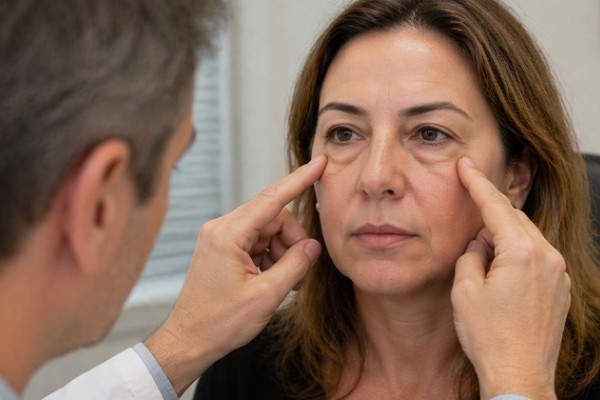
What is Natural Rhinoplasty?
Natural rhinoplasty is an approach where the nose is planned to be in harmony with the face, aiming for results that do not look like surgery has been performed.
In fact, there is no single surgical technique called "natural rhinoplasty." In my view, a result should be achieved after rhinoplasty surgery that is compatible with the general architecture of the face, does not draw undue attention, but enhances the beauty of the face. The goal is not a nose that stands out, but a look that integrates with the face.
Many of my patients share a common request: the surgery shouldn't be obvious, no one should understand I had it, but I want to look better. This is only possible through a combination of many factors. It requires good technique, aesthetic perception, and a correct analysis of the nose's harmony with the face.
In my approach, the goal is not just a beautiful nose, but a face-compatible nose. One of the most frequent pieces of feedback I receive from my patients is the sentence, "Doctor, my nose is very beautiful, but no one realizes I had surgery."
In summary, a natural nose looks aesthetic not just because it is beautiful on its own, but because it is compatible with the general structure of the face.
How is Facial Harmony Planned?
To achieve a natural result, the nose is not evaluated in isolation. It is analyzed together with the general structure of the face. For this reason, the planning process is the most critical stage of the rhinoplasty approach.
Profile Analysis
One of the critical points is the nasolabial angle. This should generally be between 95–105° in women and approximately 90–95° in men. While the dorsum line can be slightly concave in women, it should be straighter and stronger in men. An excessively upturned nasal tip creates an artificial appearance.
Frontal (Front) View
If the nasal tip is made excessively narrow, an artificial look emerges. Slight asymmetries, on the other hand, often support a more natural appearance.
Relationship with Other Facial Structures
The nose is not independent of other facial structures. Especially in patients with a receding chin, it may sometimes be necessary to intervene in the chin area to ensure balance.
Technical Approach for Natural Results
Achieving a natural nose is possible not only with an aesthetic perspective but also with the right techniques. In my clinical practice, the situation I encounter most frequently is patients wanting a natural yet noticeable change, and this balance is entirely provided by surgical experience.
Preservation Techniques
These are surgeries where corrections are made by preserving the existing structure instead of completely breaking down and reconstructing the dorsum. A more natural appearance can be achieved, and it is one of the techniques I apply.
Avoiding Excessive Resection
Removing too much bone and cartilage can result in an artificial outcome. In particular, excessive reduction of the nasal tip and exaggeration in alar reduction spoils the naturalness.
Tip Control (Nasal Tip)
The balance between rotation and projection must be correctly established. An excessively upturned nasal tip creates a "piggy nose" appearance, while insufficient lifting creates a drooping profile. The main determining factor here is the surgeon's experience.
Graft Usage
In nose surgeries, shape is generally given using septal cartilage. The goal is to support the structure and prevent collapse. A natural-looking nose is obtained by correctly positioning these structures.
The techniques used in rhinoplasty planning vary according to the patient, and this process is evaluated in detail within the scope of rhinoplasty surgery.
Most Common Mistakes That Spoil the Natural Appearance
- Applying the same nose type to every patient
- An excessively upturned nasal tip
- A very thin dorsum
- Obsession with excessive symmetry
- Creating a feminine nose in male patients
In my opinion, creating a uniform nose type, especially under the influence of social media, is one of the biggest mistakes. Everyone's facial structure and nasal anatomy are different.
Therefore, a personalized and face-compatible nose should be planned at the point where the surgeon's experience meets the patient's expectations.
Why Does a Face-Compatible Nose Look More Natural?
Naturalness is actually about not drawing attention. A nose planned in harmony with the face does not stand out on its own; it supports the general aesthetics of the face.
For this reason, after a successful surgery, people usually say "your face looks much better" instead of "the nose looks very beautiful." This is the most important indicator of correct planning.
For a natural rhinoplasty, planning should always be personalized. Facial analysis and the selection of the correct technique are the most important factors determining the naturalness of the result to be obtained.
Frequently Asked Questions
How does the nasolabial angle affect naturalness?
The secret to naturalness lies in the angle between the nose and the upper lip; planning this at 95-105° for women and 90-95° for men is a fundamental rule that prevents the nose from looking "operated on."
What is the contribution of Preservation techniques to a natural look?
In this technique, the natural bridge is preserved and the reduction is done from the base; this prevents the artificial "ski-slope" look and maintains the natural anatomical lines.
Is it noticeable from the outside that a surgery was performed?
No, with proper planning.
What is the most critical point for natural results in men?
Since male facial features are stronger, the bridge shouldn't be too curved and the tip shouldn't be over-lifted; otherwise, the masculine expression is lost, resulting in a feminine and artificial appearance.