
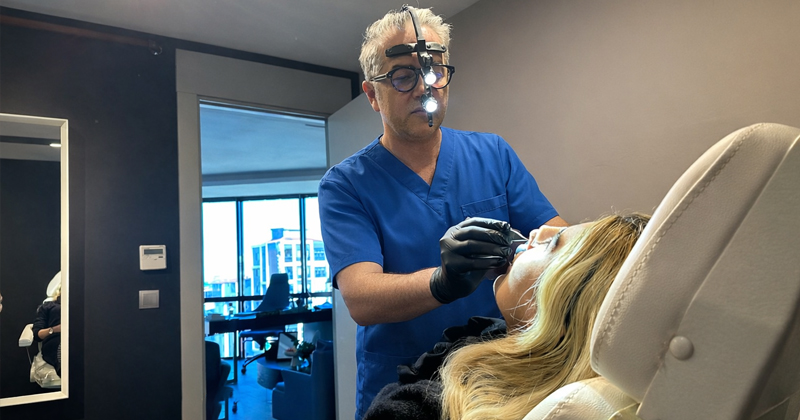
What is a Humped Nose?
A humped nose is a protruded appearance on the nasal bridge due to an excess of bone and/or cartilage. This condition can be genetic, or it may occur due to incorrect healing after trauma or a fracture.
In my own clinical practice, the humped nose is the most common reason patients apply for rhinoplasty. This protrusion, which becomes particularly evident when viewed from the side profile, can directly affect facial expression.
A humped nose is a structural condition that can be surgically corrected, and this process is an important part of rhinoplasty planning.
How Does the Surgical Process Proceed in a Humped Nose?
The aim of humped nose aesthetics is not just to remove the hump, but to bring the nasal bridge to a natural and balanced form.
The hump is a structure formed by bone, cartilage, or most often both. Therefore, both structures are evaluated together during surgery.
In the classic structural rhinoplasty approach, the bone structure is corrected with a rasp or osteotome, while the cartilage structure is reshaped.
When necessary, a smooth structure is created on the nasal bridge using cartilage grafts or flap techniques. At this point, the technique applied by each surgeon may be different; the important thing is to choose the most suitable method for the patient.
In my own surgeries, I pay particular attention to ensuring that the transitions between bone and cartilage are smooth to obtain the most seamless and natural result.
The most critical point here is that the bone and cartilage tissues should not be removed more than necessary. Excessive intervention can cause a collapsed (saddle) nose appearance.
How is a Humped Nose Corrected?
A humped nose is eliminated by the controlled correction of the bone and cartilage excess. However, the important thing here is not just to take the protrusion, but to create the new nasal bridge with a natural transition.
In my experience, a successful result is achieved by reshaping the nasal bridge not as a straight line, but with a soft line compatible with the face.
How is the Nose Shaped After the Hump is Removed?
Rhinoplasty is a whole. Just removing the hump is often not enough.
According to my aesthetic approach, removing only the hump can solve the problem in that area but does not create a beautiful nose on its own.
After the hump is removed:
- The nasal tip may remain low
- The nose may appear longer
- Profile balance may be disrupted
Therefore, in most patients, the nasal tip is also evaluated together. The tip can be lifted (rotation), or if necessary, reduced or supported.
Based on my experience, I can say that one of the most common mistakes is only removing the hump and neglecting the nasal tip.
Open or Closed Rhinoplasty: Which is Preferred?
The choice of technique is determined according to the patient's nasal structure and is usually decided together during the examination.
Closed rhinoplasty is applied without external incisions and generally provides a faster recovery. It is more frequently preferred for small and medium-level humps.
Open rhinoplasty, on the other hand, offers a wider field of view. It provides an advantage especially in asymmetries or advanced deformities.
The closed technique is a method that requires more experience on the part of the surgeon.
Especially in patients requiring revision rhinoplasty, the open technique is preferred more often.
Is Humped Nose Surgery Difficult?
Although humped nose surgery is a standard rhinoplasty procedure for most patients, a successful result depends entirely on planning.
The degree of the hump, nasal tip structure, and facial proportions should be evaluated together.
How Many Hours Does Humped Nose Surgery Take?
It usually takes between 1.5 to 3 hours. The duration may vary depending on the scope of the procedures to be performed.
Can the Nasal Hump Recur After it is Removed?
In surgeries performed with the correct technique, the hump does not recur. However, it is important to pay attention to the healing process.
What Should a Natural Result Be Like?
I prefer the results of the surgery to look natural in all my patients. That is, the nose should not look like it has been operated on.
- There should be a soft transition in the profile
- Harmony with the face should be preserved
- Personalized planning should be made
In male patients, it is important not to make the nasal bridge too hollow. In female patients, a slight curve can provide a more aesthetic appearance.
Most Common Mistakes in Humped Nose Aesthetics
- Excessive hump removal (collapsed nose)
- Leaving an open roof deformity
- Intervening only in the hump
- Making a male nose feminine
Most of these errors result from a lack of planning.
Conclusion: What Matters is Balance, Not the Hump
The main goal in humped nose aesthetics is not just to take the hump, but to create a nose that is balanced and compatible with the face.
In my own approach: I do not consider any result that does not look natural as successful.
Therefore, the planning process is the most critical stage of the surgery.