
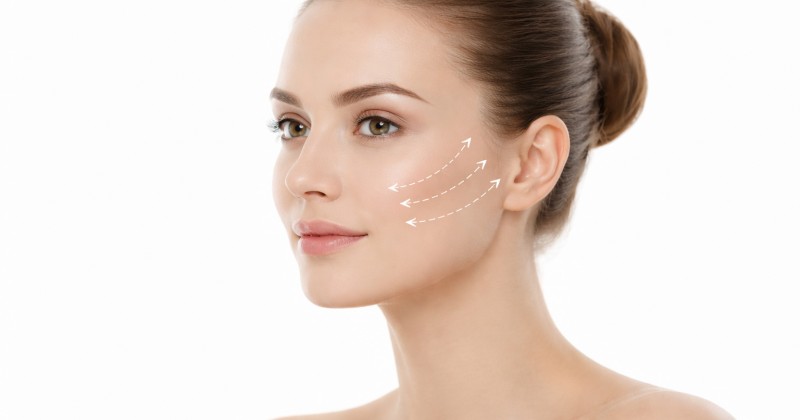
Is Mini Facelift Suitable for Every Face Structure?
Mini facelift is a surgical facial rejuvenation approach targeting mild-to-moderate sagging starting in the lower face and jawline. However, it is not correct to see this method as a “one-size-fits-all” solution. The type of aging, direction of sagging, condition of the neck area, and skin elasticity are the fundamental factors that determine whether a mini facelift will be sufficient on its own.
[Image of facial fat pads and muscle layers aging]Are Non-Surgical Methods Always an Alternative?
Non-surgical aesthetic applications such as Botox, fillers, and treatments supporting skin quality can be beneficial for patients with mild lines and volume loss. However, if there is significant sagging, the results achievable with these methods may remain limited.
Especially in some patients who have loss of clarity only in the jawline without significant sagging in the lower face, non-surgical applications such as jawline filler can be evaluated as an alternative or supportive option to surgery. The suitability of such applications should be determined by considering face structure and expectations together.
What is the Action Area of a Mini Facelift?
A mini facelift mostly focuses on the need for recovery in the lower face and jawline region. The aim is to obtain a more vigorous appearance in an unexaggerated way without disturbing the facial expression. Therefore, a mini facelift can be a more meaningful option for patients who do not have advanced sagging and whose skin quality is relatively preserved.
[Image of mini facelift vs full facelift incision sites]When Might a Mini Facelift Not Be Enough?
Even if a mini facelift gives results in some patients, it may not provide the expected recovery alone in certain situations. The main reason for this is that aging signs can occur not only in the skin but also in the deep support tissues of the face and the neck area.
1) Advanced Lower Face Sagging and Significant “Jowl” Formation
If there is significant contour loss in the jawline and advanced downward displacement in the cheek tissues, a mini facelift may remain limited. In these patients, more comprehensive facelift techniques can provide a more balanced and permanent recovery.
2) Significant Loosening in the Neck and Jowl Area
Since the mini facelift focuses mainly on the lower face, it may not give sufficient results alone in patients with significant skin excess in the neck area, jowl accumulation, and neck bands (platysma bands). In this case, planning including the neck area may be more accurate.
[Image of platysma muscle bands in neck]3) Significantly Decreased Skin Elasticity
As skin elasticity decreases, it may become difficult to obtain a “smooth and balanced” result with limited recovery. Especially in people with long years of intense sun exposure, smoking, or significant weight changes, skin quality can affect the mini facelift result.
4) Predominance of Mid-Face Problems
In some patients, the main problem is not the lower face, but volume loss in the mid-face and the downward movement of the cheek area. In such a case, since the mini facelift only focuses on the lower face, it may not fully meet the “main complaint”. Mid-face evaluation is critically important in planning.
5) Expectation of “Very Big Change with a Single Procedure”
Mini facelift, as the name suggests, is a more limited intervention. Therefore, satisfaction may decrease in patients expecting a very dramatic change at once. Correct expectation management is as important as the correct technique.
Which Approaches Can Be Evaluated Instead of a Mini Facelift?
A mini facelift may not be suitable for everyone; however, this does not necessarily mean “the only option is a classic facelift”. By evaluating the face and neck together during the examination, different techniques can be planned according to the person's needs. More comprehensive surgical approaches in some patients and combined supportive applications in others may give more balanced results.
Why is Correct Candidate Selection So Important?
When applied to the right patient, a mini facelift can provide a more vigorous appearance without disturbing the facial expression. However, it may not be sufficient alone in cases such as advanced sagging, significant neck problems, or low skin elasticity. The most accurate approach is to evaluate the face and neck structure together, clarify expectations, and provide personalized planning.
Note: This content is for informational purposes. The most suitable method is determined personally after examination and facial analysis.
Would you like me to create a 3D simulation visualization for a personalized face structure analysis?