
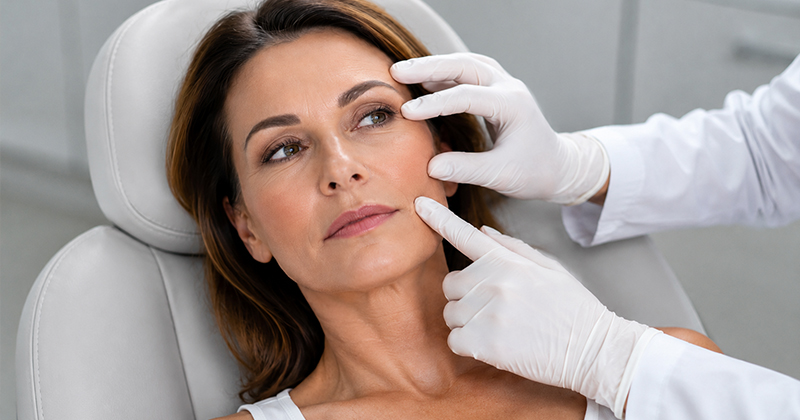
What is Midface Lift Aesthetics?
Midface lift is a facial rejuvenation method that focuses especially on the cheekbone area, cheeks, and nasolabial lines, targeting sagging and volume loss in the middle part of the face. When planning midface lift aesthetics in Samsun, the goal is to carry the cheeks and cheekbone area to a higher, more balanced, and natural position.
With age, soft tissues in the midface area shift downwards. This situation can lead to loss of fullness in the cheekbone area, deepening of nasolabial lines, and a “tired and shifted downwards” expression in the middle part of the face. Midface lift addresses these changes as a part of the facelift approach.
Which Region Does the Midface Represent?
The face is roughly divided into three regions aesthetically and surgically:
- Upper face: Forehead, eyebrows, and eye area,
- Mid-face: Cheekbone area, cheeks, nasolabial lines, and lower eyelid–cheek transition,
- Lower face and neck: Jawline, area around the mouth, jowl, and neck.
Midface lift focuses on sagging and volume loss in this mid-face area. When necessary, it can be planned together with Deep Plane Facelift or SMAS Facelift.
Changes Seen in Midface Aging
In the midface area over time:
- Cheek fat pads shift downwards,
- The cheekbone area loses its fullness,
- Nose edge lines (nasolabial lines) become prominent,
- The lower eyelid–cheek transition sharpens and shadows.
Midface lift aesthetics aims to achieve a younger, more rested, and more balanced appearance by carrying the soft tissues in this region upwards with more natural vectors.
In Which Situations is Midface Lift Considered?
Complaints frequently voiced by patients in Samsun midface lift aesthetics evaluation are as follows:
- The cheeks appearing shifted downwards and the center of the face appearing to have slipped downwards,
- Nasolabial lines becoming prominent and shadowing around the mouth,
- Volume loss and flat appearance in the cheekbone area,
- Hollow and tired expression in the lower eyelid–cheek transition.
In some patients, this picture is accompanied by lower face and neck sagging. In this case, combined planning with Facelift, Deep Plane Facelift, and Neck Aesthetics may come to the agenda.
Who Can Be a Suitable Candidate for Midface Lift?
In general, patients with the following characteristics can be evaluated for a midface lift:
- Those with significant sagging and volume loss in the midface area,
- Those who notice downward displacement in the cheekbone and cheek area,
- Those who are uncomfortable with the prominence of nasolabial lines,
- Those whose general health status is suitable for facial aesthetic surgery.
During the examination, the face is evaluated from a Combined Facial Aesthetics perspective, together with Eyelid Aesthetics, Eyebrow Lift Aesthetics, and Facelift.
How is Midface Lift Aesthetics Performed in Samsun?
Midface lift can be applied with different approaches according to the technique used and the patient's need. Some techniques focus more on carrying cheek soft tissues upwards, while others handle the lower eyelid and cheekbone line together.
Approaches and Location of Incisions
In midface lift, incisions can be planned according to the technique to be performed:
- At the lower eyelid margin (combined approach with lower eyelid aesthetics),
- In areas close to the ear circumference and hairline (combined approach with facelift),
- In some techniques, with small incisions made in the temple (temporal) region using the endoscopic method.
The method to be preferred is determined according to the facial anatomy, direction of sagging, and previously performed procedures.
General Principle of Midface Lift Technique
Even if the technique used changes, the basic principle of midface lift is similar:
- Release of soft tissues and supporting ligaments in the midface area,
- Carrying the cheek and cheekbone area to a higher position, opposite to the direction of sagging,
- Softening the shadowing in the nasolabial region,
- Fixing the carried tissues to their new position with sutures.
The goal is not to "inflate" the cheeks, but to make the midface fuller, more rested, and harmonious with the rest of the face.
Relationship Between Midface Lift and Deep Plane / SMAS Facelift
Midface lift is frequently mentioned together with Deep Plane Facelift and SMAS Facelift. This is because some of these techniques can also affect the midface tissues.
Which Technique in Which Situation?
The general framework when making a plan can be evaluated as follows:
- Significant midface sagging, strong cheek drooping: Midface lift and deep plane techniques can be considered together.
- Predominant lower face and jawline sagging: SMAS Facelift or SMAS Plication may be more prominent.
- Mild-to-moderate sagging: In suitable patients, more limited techniques such as Mini Facelift can be preferred.
Which method is more logical is determined by evaluating the entire face during the examination. The same technique does not have to be used on every patient.
Midface Lift and Non-Surgical Methods
In some patients, mild sagging and volume loss in the midface area can be managed for a while with non-surgical aesthetics methods such as filler applications, liquid facelift, mesotherapy, and youth vaccine, or their combinations.
When Does Surgical Midface Lift Come to the Agenda?
In the following situations, non-surgical methods alone may not be sufficient and surgical midface lift is evaluated:
- Cheek drooping that cannot be sufficiently corrected with filler,
- Midface volume loss that creates a constant need for filler,
- Significant sagging and shadowing in the nasolabial region,
- Hollowing at the lower eyelid–cheek transition becoming structural.
The goal in this picture is not only to fill the midface with volume but to carry the soft tissues to a more anatomical position.
Recovery Process After Midface Lift
The recovery process may vary according to the chosen technique, age, skin structure, and additional procedures. Generally:
- In the first days, swelling and a feeling of tension may be seen in the midface and cheeks.
- Bruising may last for a while, especially around the cheeks and lower eyelids.
- Keeping the head slightly elevated can increase comfort in the first period.
- Short walks and light movements can be encouraged from the time recommended by the physician.
A large part of the swelling recedes in the first weeks. The adaptation of the midface tissues to their new position and the more natural, more settled appearance of the facial features become prominent within a few weeks to a few months.
Scars and Natural Appearance of the Midface
Depending on the technique used, incisions can be placed in the lower eyelid line, around the ear, or in areas close to the hairline. The final appearance of the scars is closely related to skin structure, wound healing characteristics, smoking, and compliance with post-operative care recommendations.
The goal in midface lift surgeries is not to change the face beyond recognition. The goal is to provide the person's own face with a more rested, fuller, and more balanced appearance.